Some of the strongest objections in Servus Christi’s The Pretrib Rapture Deception: A False Hope are pastoral rather than technical. Does pre-tribulation teaching make Christians expect exemption from suffering? Does it misuse Paul’s command to “encourage one another”? Does it turn Enoch and Noah into a timetable? Does it weaken Jesus’ warnings about persecution and readiness?
Christians are promised tribulation in the present age and must be prepared to suffer faithfully. The comfort of 1 Thessalonians 4 is first the resurrection and reunion of believers, not a guarantee of an easy life. Typology can illustrate deliverance but cannot establish timing. Pre-tribulation hope is defensible only when it produces endurance, holiness, service, and courage rather than complacency.
The Comfort of 1 Thessalonians 4
The objection says that pre-tribulationists change Paul’s comfort. The Thessalonians grieved deceased believers; Paul comforted them by promising resurrection and reunion. The passage does not explicitly say, “You will escape the Tribulation.” Critics therefore argue that using “comfort one another” as proof of pre-tribulation timing imports a concern Paul was not addressing.
This objection is correct about the primary purpose. Paul’s comfort is that the dead in Christ will rise, the living will not precede them, both groups will meet the Lord, and all will always be with Him. That comfort must never be reduced to avoiding hardship.
The timing question still matters secondarily. Paul continues into the day of the Lord and says believers are not appointed to wrath. Pre-tribulation interpreters see the gathering and non-appointment to wrath as a coherent pastoral sequence. But the command to comfort supports the whole hope of resurrection, reunion, Christ’s presence, and deliverance, not a standalone timing proof.
Persecution and the Future Tribulation
Jesus says His followers will have tribulation in the world. Paul says everyone who desires to live a godly life will be persecuted. Peter prepares churches for fiery trial. Revelation calls saints to endurance. Church history confirms that believers have suffered imprisonment, displacement, violence, and martyrdom.
Servus Christi correctly warns that teaching can be spiritually dangerous if it tells Christians they will never suffer. A church trained only to expect prosperity may be shocked when obedience becomes costly. Pre-tribulation teachers should preach the full New Testament doctrine of suffering and should stand with persecuted Christians now.
The pre-tribulation distinction is between present tribulation and the future eschatological wrath of the day of the Lord. Christians may suffer because of the world, the flesh, the devil, rulers, or persecutors. The future judgment period involves God’s judicial action against a rebellious world and a renewed focus on Israel. A reader may dispute that distinction, but it is inaccurate to answer it as though pre-tribulationism simply says, “God would never let Christians be hurt.”
| Present Christian tribulation | Future day-of-the-Lord wrath |
|---|---|
| Explicitly promised to Christ’s followers | Described as divine judgment on rebellion and earth-dwellers |
| May come through persecution, loss, illness, or social hostility | Unfolds through the prophetic judgment sequence |
| Calls for endurance, witness, love, and faithfulness | Raises the timing question in 1 Thessalonians 5 and Revelation 3:10 |
| Has marked the church throughout history | Is connected by futurists with Daniel’s final week and Israel |
Would Pre-Tribulation Hope Leave Believers Unprepared?
A doctrine can be taught badly even if it is true. If a teacher says believers need not prepare spiritually, practically, or emotionally for persecution because the rapture will occur first, the teaching conflicts with Jesus and the apostles. The church should cultivate courage, mutual care, biblical literacy, generosity, and willingness to lose status or safety for Christ.
Properly taught, imminence should deepen preparedness. If Christ may gather His church without a revealed prerequisite, believers should remain faithful now. They should not postpone repentance, reconciliation, mission, or costly obedience. Readiness is moral and spiritual, not possession of a survival chart.
Pre-tribulation hope also does not eliminate prudent preparation for ordinary crises. Christians may plan for emergencies, care for vulnerable neighbors, and support persecuted churches while refusing fear-driven stockpiling or prophetic panic.
Jesus’ Warnings Must Be Heard
Jesus warns disciples about hatred, betrayal, false teaching, persecution, and endurance. In the Olivet Discourse He also speaks of abomination, great tribulation, cosmic signs, His visible appearing, and an angelic gathering. Pre-tribulation readers sometimes assign every warning exclusively to Israel or a future remnant too quickly.
The warnings have at least enduring moral force for the church: do not be deceived, do not grow cold, endure faithfully, watch, serve, and remain ready for the Master. Questions about the discourse’s prophetic audience do not erase those commands.
The timing disagreement in Matthew 24 concerns the specific post-tribulation sequence, not whether Christians should heed Jesus. Pre-tribulationism may distinguish the church’s rapture from the public appearing while still receiving Christ’s warnings as essential discipleship.
Enoch and Noah as Typology
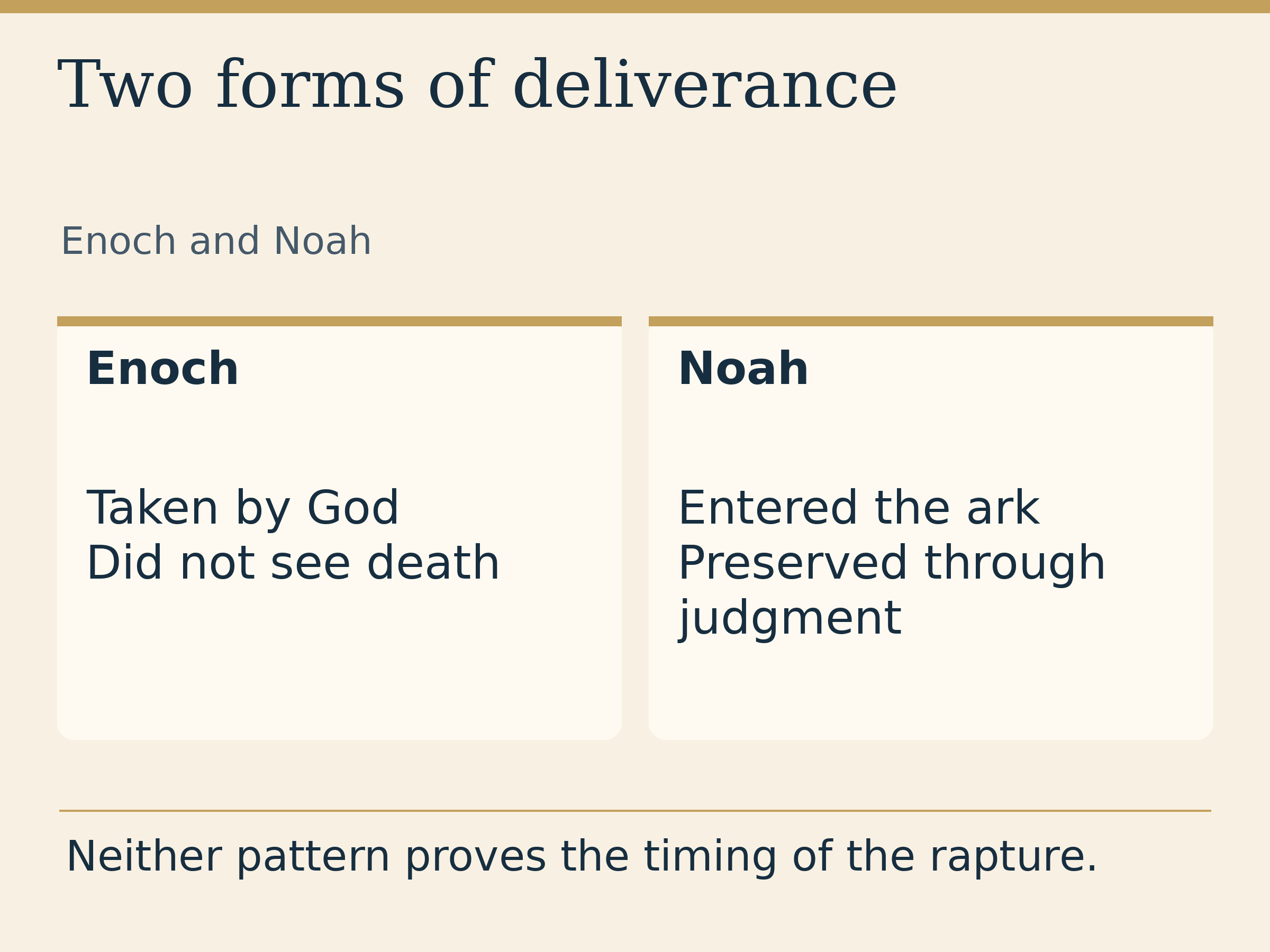
Enoch was taken by God and did not see death. Noah entered the ark before the flood and was preserved through judgment. Pre-tribulation teachers sometimes present Enoch as a picture of the church removed before judgment and Noah as a picture of Israel preserved through it.
The objection says this is selective. If Noah represents preservation through tribulation, why should Enoch control the church’s timing? Genesis does not explicitly connect Enoch’s translation with the flood, and the New Testament does not call either man a rapture timetable.
The objection is correct that typology cannot prove timing. Enoch and Noah show different forms of divine deliverance: removal from death and preservation through judgment. They are compatible with the pre-tribulation framework, but the doctrine must stand on direct rapture, wrath, and prophetic-sequence texts.
| Pattern | What the text shows | Limit |
|---|---|---|
| Enoch | God took a faithful man so that he did not experience death. | Genesis does not identify his translation as a type of pre-tribulation timing. |
| Noah | God sheltered a household before and through worldwide judgment. | The ark does not prove that the church remains on earth during the future Tribulation. |
| Lot | Judgment did not fall on Sodom until Lot had left. | A narrative pattern does not define the church’s prophetic identity. |
| Passover and Exodus | God can distinguish His people while judgment falls. | Divine protection can support more than one timing model. |
The “Escape Theology” Charge
Calling pre-tribulationism “escape theology” can identify a real abuse but can also confuse categories. Christianity includes many promises of deliverance: rescue from condemnation, resurrection from death, preservation in trial, and final liberation from evil. Desire for Christ to deliver His people is not automatically cowardice.
The problem arises when hope becomes entitlement. No Christian should assume that faith guarantees safety from war, persecution, sickness, or martyrdom. The rapture is not a claim that one generation is morally superior to earlier martyrs. It is a proposed place for the church’s corporate gathering within God’s future program.
Where the Objections Overreach
The objections overreach when any promise of deliverance is treated as cowardice, when present persecution is equated without argument with the future day of divine wrath, or when misuse of a doctrine is made to disprove the doctrine. Paul can comfort grieving believers with resurrection and still place that hope next to deliverance from wrath. Jesus can prepare disciples for suffering while Scripture also distinguishes a future judgment period.
Preparedness Without Panic
Whatever rapture view a Christian holds, faithful preparedness includes the same core practices:
- Know the gospel and Scripture well enough to recognize false teaching.
- Build church relationships capable of carrying practical burdens.
- Pray for and materially support persecuted believers.
- Teach children and new believers that following Christ can be costly.
- Refuse dates, fear marketing, and claims of secret prophetic knowledge.
- Live ready for Christ by practicing repentance, truthfulness, mercy, and mission.
Pastoral usefulness cannot prove a timing view. A doctrine is not true merely because it comforts or false merely because it can be abused. The biblical arguments about the sequence remain decisive.
Comfort the Grieving, Prepare for Costly Obedience
The blessed hope should make Christians harder to frighten and more willing to suffer, not less. Christ will raise the dead, transform His people, judge evil, vindicate faithful witnesses, and complete His promises. Until then, the church should comfort the grieving, prepare believers for costly obedience, and hold every prophetic conclusion beneath the authority of Scripture.
Scripture and Further Reading
Servus Christi. The Pretrib Rapture Deception: A False Hope. YouTube video. Pastoral and typological objections to pre-tribulationism.
The Holy Bible, especially Genesis 5–8; Matthew 24–25; John 16:33; 1 Corinthians 15:50–58; 1 Thessalonians 4:13–5:11; 2 Timothy 3:12; 1 Peter 4:12–19; Revelation 3:10; 13:7–10; 20:4–6. These passages describe deliverance, suffering, resurrection, comfort, wrath, and endurance.
Beale, G. K. Handbook on the New Testament Use of the Old Testament: Exegesis and Interpretation. Baker Academic, 2012. A guide to interpreting the New Testament’s use of earlier Scripture.
Green, Gene L. The Letters to the Thessalonians. Pillar New Testament Commentary. Eerdmans, 2002. Paul’s pastoral setting of grief, comfort, persecution, watchfulness, and the day of the Lord.
Ladd, George Eldon. The Blessed Hope. Eerdmans, 1956. A non-pre-tribulation premillennial account of Christian hope.
Morris, Leon. The First and Second Epistles to the Thessalonians. Revised edition. New International Commentary on the New Testament. Eerdmans, 1991. Commentary on Paul’s argument about deceased believers, encouragement, and wrath.
Walvoord, John F. The Rapture Question. Revised and enlarged edition. Zondervan, 1979. The classic pre-tribulation distinction between present suffering and future eschatological wrath.