Servus Christi’s video The Pretrib Rapture Deception: A False Hope presses the exegetical questions that matter most: whether Matthew 24 and 1 Thessalonians 4 describe the same gathering, whether the church is really absent from Revelation’s judgment scenes, whether imminence survives passages that name prior events, and whether pre-tribulation interpreters divide Christ’s coming by changing terminology when convenient.
Similar vocabulary matters, argument from silence has limits, and no disputed Greek word can carry the whole doctrine. The pre-tribulation case remains coherent when each passage is read in its own audience, sequence, purpose, and literary context, then brought into a cumulative synthesis.
Matthew 24 and 1 Thessalonians 4
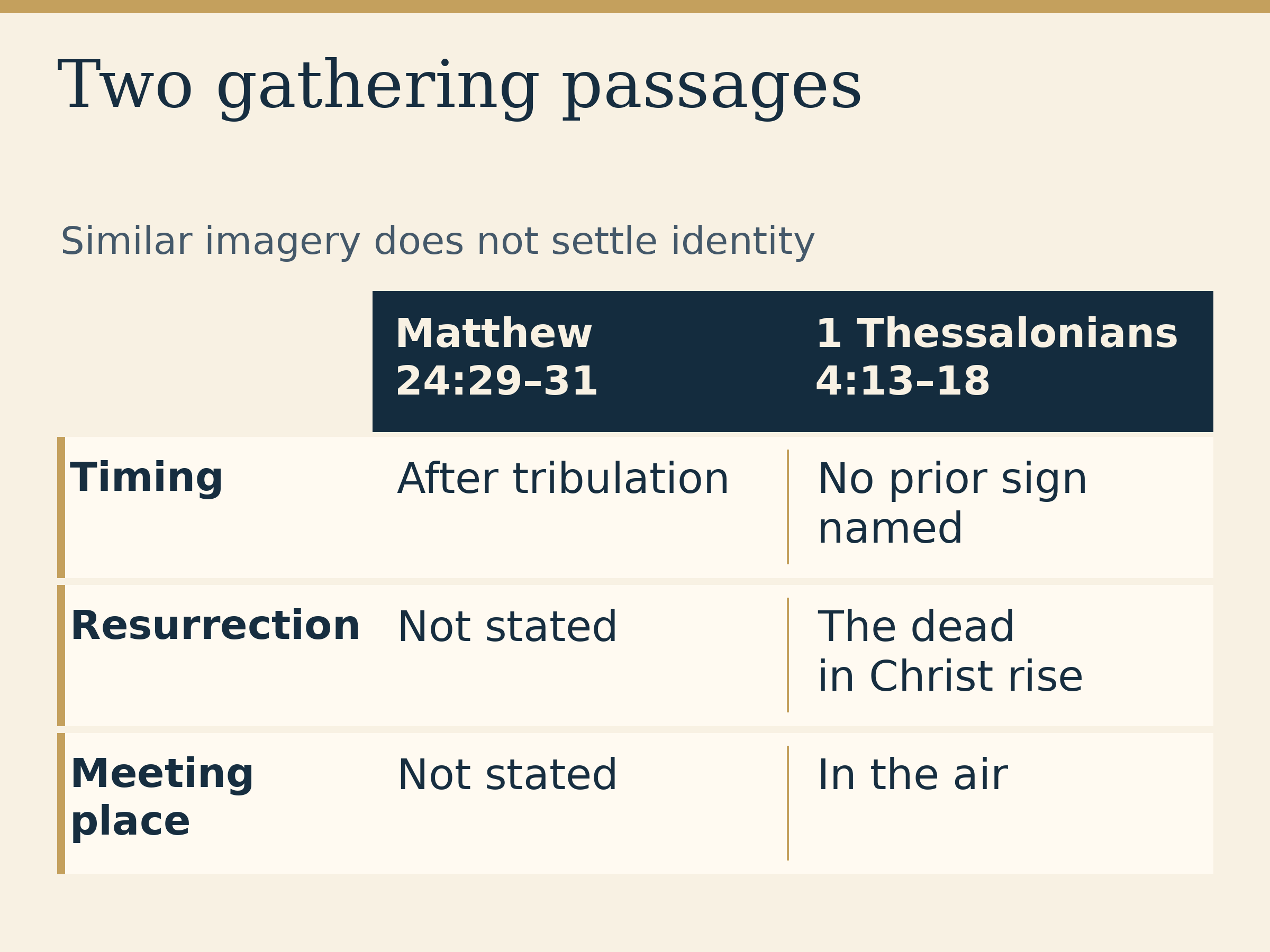
The objection is powerful because both passages concern Christ’s coming and a gathering. Matthew 24 includes clouds, angels, a trumpet, and the gathering of the elect after the Tribulation. First Thessalonians 4 includes the Lord’s descent, an archangel’s voice, God’s trumpet, clouds, and believers meeting the Lord. The shared imagery makes comparison unavoidable.
The disagreement concerns identity, not relevance. Matthew 24:29–31 follows the abomination, great tribulation, and cosmic signs. Angels gather the elect in a public Son-of-Man scene. The passage does not state that the dead in Christ rise, living believers are transformed, or the gathered meet Christ in the air. First Thessalonians 4 centers on resurrection and the meeting in the air; 1 Corinthians 15 supplies the transformation. Paul lists no preceding sign sequence in 1 Thessalonians 4.
The pre-tribulation reading understands Matthew 24 as the visible, sign-preceded appearing and gathering associated with Israel and the kingdom, while Paul explains the church’s resurrection and catching up. This distinction is an inference from features and context; Matthew never says, “This gathering excludes the church,” and Paul never says, “This is not Matthew 24.” The full comparison of Matthew 24 and Paul’s gathering turns on these differences, not on denying the shared imagery.
The “Missing Church” Observation in Revelation
The objection says that the disappearance of the Greek word ekklesia after Revelation 3 proves little. Revelation changes genres and scenes, and the book still describes saints, servants, witnesses, martyrs, and a great multitude. An author can speak about the church without repeating one preferred label.
That critique is correct. An argument from silence is not direct proof, and “saints” cannot be treated as unbelievers. God has faithful people during the beast’s persecution.
The observation still has cumulative value. Revelation directly addresses churches on earth in chapters 2–3, moves to a throne-room before the seals, and then speaks of earth-dwellers, sealed Israelites, witnesses, saints, and beast worshipers. The churches are not addressed as an earthly body during the seals, trumpets, and bowls. Pre-tribulationism explains this change by distinguishing the church’s present calling from people saved during the Tribulation.
Revelation’s vocabulary and structure fit a prior gathering; they do not prove it without the clearer rapture and wrath passages.
Imminence and Events That Must Occur
The objection points to Jesus’ signs, Paul’s apostasy and man of lawlessness, Peter’s future suffering, and other predicted events. If Christians knew that certain things would happen before Christ’s return, how can the rapture have been possible at any moment?
Pre-tribulation imminence is narrower: no revealed event must occur before Christ gathers His church. Signs belong to the public appearing, and events such as Peter’s death were relevant to particular people without becoming a perpetual sign required for the entire church. Believers are repeatedly taught to wait for Christ and live ready, not to wait first for the beast, the abomination, or cosmic collapse. This is readiness without date-setting; the imminence discussion examines the predicted events in detail.
Second Thessalonians 2 remains the hardest pressure point. Paul discusses the gathering, panic about the day of the Lord, apostasy, the man of lawlessness, and restraint. The pre-tribulation reply need not translate apostasia as “rapture.” It argues that Paul corrects fear that the day of the Lord is present and that the restraint of lawlessness must be removed before the lawless one reaches his appointed manifestation.
Greek Terms for Christ’s Coming
The video argues that pre-tribulationism divides passages using the same words, especially parousia (coming or presence), apokalypsis (revelation), and epiphaneia (appearing). If the vocabulary overlaps, critics say, the New Testament is describing one event rather than two separated stages.
The objection correctly notices that Greek words do not function as technical labels that automatically mean “rapture” in one place and “second coming” in another. Parousia can describe Christ’s future coming broadly. Vocabulary alone cannot establish two stages.
The point of disagreement is whether one broad term may cover a complex event with distinguishable movements. Context gives the participants, direction, purpose, signs, and results. The same word can refer to a whole visit while different passages describe different features of that visit. The case for distinguishable stages rests on contextual contrasts, not exclusive word meanings.
Does “Meet the Lord” Require an Immediate Return to Earth?
Post-tribulation interpreters compare the noun apantēsis, “meeting,” with ancient civic receptions in which people went out to greet a dignitary and escorted him back into the city. Acts 28:15 describes believers going out to meet Paul and returning with him. Matthew 25:6 uses the word for meeting the bridegroom. Critics argue that believers rise to welcome Christ and immediately accompany Him to earth.
This background is relevant and should not be dismissed. The word can occur in reception settings. It does not, however, encode the direction of travel as an unbreakable lexical rule. First Thessalonians 4 never states that the party immediately reverses direction, while John 14 speaks of Christ receiving His people in connection with the Father’s house. The meeting image and its ancient reception background contribute to interpretation, but the surrounding passages must decide the destination and sequence.
The Apostasy in 2 Thessalonians 2:3
Some pre-tribulation advocates interpret apostasia as a physical departure and identify it with the rapture. The video objects that the normal Greek meaning is rebellion or defection and that making it the rapture creates an awkward statement.
Standard lexical usage and Acts 21:21 favor rebellion or apostasy. Early English “departure” translations can denote departure from the faith and do not prove a spatial rapture; the study of apostasia in 2 Thessalonians 2:3 explains the distinction.
Rejecting the rapture meaning does not establish post-tribulationism. Paul’s main pastoral problem is the false claim that the day of the Lord is present. The text can be read with apostasia as rebellion while the timing of the church’s gathering is established elsewhere.
The Restrainer
Paul says the Thessalonians know what restrains the lawless one and speaks of both a restraining force and a restraining person. Proposed identities include government, angelic power, gospel proclamation, Michael, the Holy Spirit, and the Spirit’s work through the church.
Paul does not explicitly name the restrainer in the surviving letter. Identifying the restrainer as the Holy Spirit in the church is therefore an inference.
Pre-tribulation interpreters favor that inference because the restrainer must be capable of holding back the satanically empowered lawless one across generations and then be “out of the way” without ceasing to be divine. The Spirit’s special church-age ministry can change without the Spirit becoming absent from the world; people are still saved during the Tribulation. The competing identifications of the restrainer remain a question of inference, not an explicit identification by Paul.
Tribulation Saints
Revelation undeniably contains saints during the Tribulation. A great multitude comes out of great tribulation; the beast makes war on saints; worshipers refuse the mark; martyrs are later raised. The objection says these believers are the church, so the church remains on earth.
Grace does not end, and later believers are not spiritually inferior: a saint is a holy person belonging to God.
The disagreement concerns corporate identity and administrative calling. Scripture calls Old Testament believers saints without making them members of the New Testament church before Pentecost. Pre-tribulationism likewise understands Tribulation believers as redeemed by Christ without requiring that the church in its present form remains in Daniel’s final week. The relationship between these saints and the church requires attention to Revelation’s distinctions among sealed Israel, a multinational multitude, witnesses, and martyrs.
One Coming or Two?
The objection often says that pre-tribulationism creates a third coming: Christ came in humility, comes secretly for the church, and comes again publicly. That language can make the view sound like two unrelated future returns.
Pre-tribulationism teaches one future coming program of the same Christ with distinguishable phases or movements. At the rapture He receives and transforms His church; at the glorious appearing He is manifested publicly in judgment and kingdom victory. The unity lies in the Person and future advent; the distinctions lie in audience, direction, signs, and purpose.
Whether Scripture permits distinct phases within one future coming is the real debate. Merely counting uses of “coming” does not settle it.
Why the Cumulative Reply Still Holds
The objections weaken several careless arguments without overturning the whole case. Paul still describes resurrection and catching up without a sign sequence. John 14 still gives reception-to-the-Father’s-house language. First Thessalonians 5 still connects the day of the Lord with non-appointment to wrath. Revelation 3:10 still concerns a coming worldwide hour. Daniel 9 still frames the final week around Israel and Jerusalem. Revelation still changes addressed groups before the judgment sequence. Romans 11 still preserves a future for Israel.
Pre-tribulationism does not need every supporting point to be equally strong. It needs the combined reading to explain the texts more coherently than the alternatives.
Scripture and Further Reading
Servus Christi. The Pretrib Rapture Deception: A False Hope. YouTube video. Objections concerning the gathering, Revelation’s saints, imminence, and coming terminology.
The Holy Bible, especially Matthew 24:15–31; John 14:1–3; Acts 21:21; 28:15; 1 Corinthians 15:50–54; 1 Thessalonians 4:13–18; 5:1–11; 2 Thessalonians 2:1–12; Revelation 3:10; 7; 13–14; 20. These passages describe the gathering, resurrection, wrath, rebellion, restraint, and saints under persecution.
Danker, Frederick W., ed. A Greek-English Lexicon of the New Testament and Other Early Christian Literature. 3rd ed. University of Chicago Press, 2000. Lexical entries for apostasia, parousia, and related vocabulary.
Green, Gene L. The Letters to the Thessalonians. Pillar New Testament Commentary. Eerdmans, 2002. Exegetical and pastoral context for both Thessalonian letters.
Gundry, Robert H. The Church and the Tribulation. Zondervan, 1973. A detailed post-tribulation case on Matthew 24, imminence, vocabulary, and the church in tribulation.
Walvoord, John F. The Rapture Question. Revised and enlarged edition. Zondervan, 1979. A classic pre-tribulation response to the timing objections.
Wanamaker, Charles A. The Epistles to the Thessalonians: A Commentary on the Greek Text. New International Greek Testament Commentary. Eerdmans, 1990. Greek-text commentary on 1–2 Thessalonians.