Servus Christi’s video The Pretrib Rapture Deception: A False Hope argues that the pre-tribulation rapture lacks a credible place in church history and arose within a later theological environment. That objection deserves a careful answer because pre-tribulation advocates have sometimes overstated weak historical evidence. The fair question is not, “Can a modern system be found word for word in the earliest centuries?” It is, “What did earlier Christians actually teach, when was the developed view systematized, and what can history prove about biblical truth?”
The short answer is that John Nelson Darby systematized and promoted a developed dispensational pre-tribulation framework in the nineteenth century. It does not follow that Darby invented every component without precedent or that the doctrine is false. Earlier sources contain futurist expectations, distinctions among prophetic groups, and occasional ideas of deliverance before eschatological judgment. Most do not present the later system in full. Scripture, not historical popularity, must decide the doctrine.
The Historical Objection Stated Fairly
The strongest historical objection has several parts. Early Christians expected persecution and often anticipated the church’s conflict with Antichrist. Clear statements of a pre-tribulation rapture are difficult to locate before the modern era. Darby developed a distinctive church-and-Israel framework, and the doctrine spread through prophecy conferences, Bible institutes, missionary networks, and the Scofield Reference Bible. Critics therefore argue that pre-tribulationism is a late innovation read back into Scripture.
This case correctly notices the relative lateness of the fully developed system. It also correctly warns against presenting ambiguous figures as if they taught modern dispensationalism. Historical honesty requires more than collecting any sentence about being “caught up,” escaping trouble, or meeting Christ.
Darby’s Distinctive Synthesis
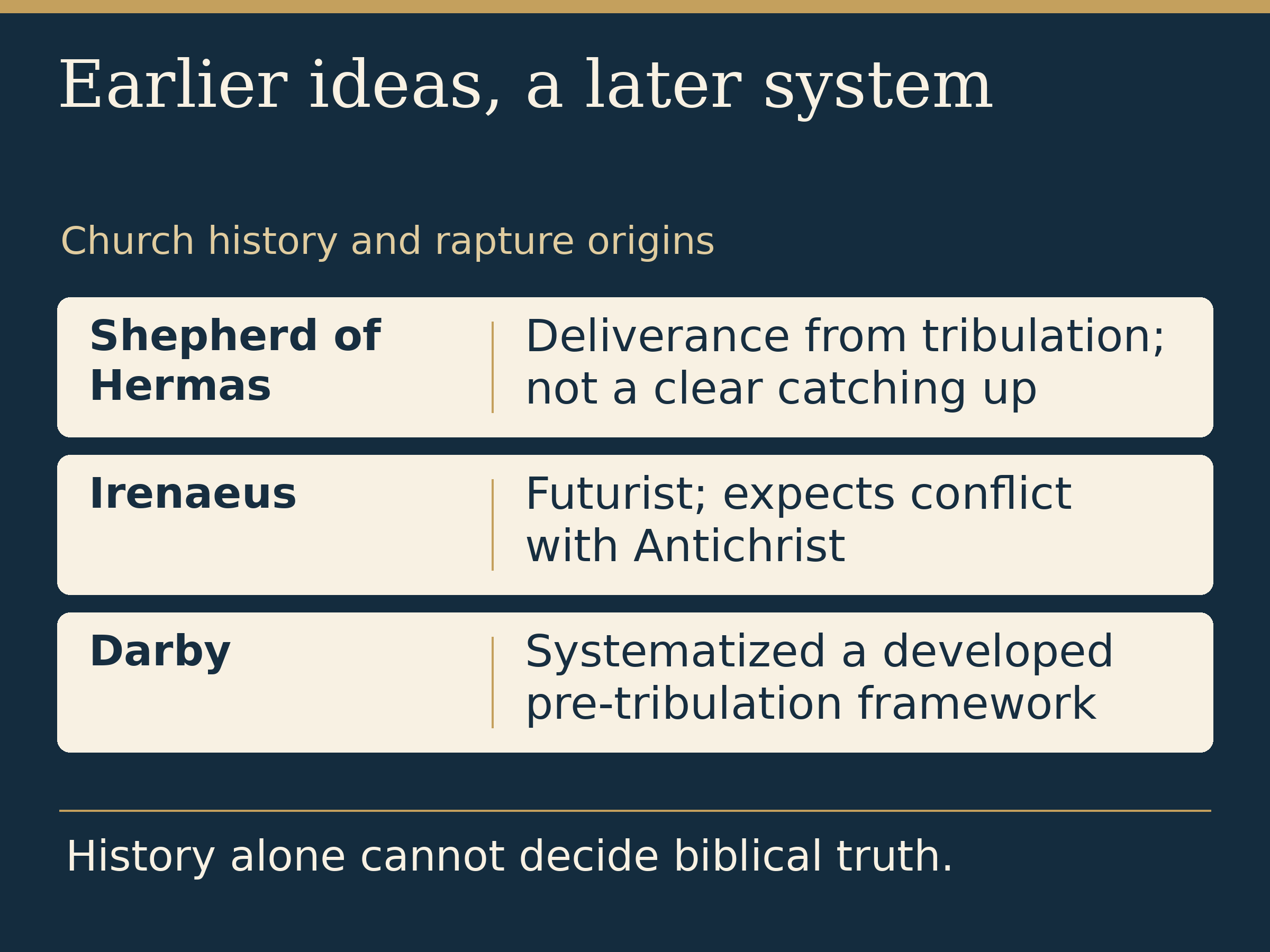
Darby did more than repeat a familiar consensus. He articulated a sharp distinction between the church’s heavenly calling and Israel’s earthly prophetic program, connected that distinction with a prior gathering of the church, and placed a Jewish remnant within a future period of tribulation before Christ’s public manifestation. His writings and the wider Brethren movement helped systematize ideas that later became characteristic of dispensational pre-tribulationism.
Calling Darby a systematizer is historically stronger than calling him an inventor in the absolute sense. The components he used came from Scripture and from earlier Christian debates about futurism, the millennium, Israel, Antichrist, resurrection, and Christ’s coming. His synthesis was distinctive and influential, but a synthesis can be new in arrangement without every element being new.
Nor does historical influence establish biblical truth. A doctrine is not true because Darby taught it, and it is not false because Darby helped organize it. The genetic fallacy occurs when a claim is judged solely by its alleged source instead of by its evidence. History can expose exaggeration and trace development; it cannot replace exegesis.
Pseudo-Ephraem’s Pre-Crisis Gathering
A sermon commonly called Pseudo-Ephraem speaks of believers being drawn away before the final crisis. Its authorship, date, and meaning are disputed: the deliverance may refer to death or providential escape rather than the rapture of living believers. It is an earlier anticipation, not evidence that the early church broadly taught modern pre-tribulationism. The Latin sermon and its historical limitations receive fuller treatment in the pre-Darby source study.
Other Early-Church Claims
Pre-tribulation writers have appealed to the Shepherd of Hermas, Irenaeus, and other early sources. These appeals require caution. Hermas describes faithful escape from coming tribulation, but the scene is better read as divine preservation and moral readiness than as a clear catching up to heaven. Irenaeus was futurist and premillennial, but his broader sequence expects the church’s conflict with Antichrist; he should not be presented as a straightforward pre-tribulation witness.
What these sources do show is that early Christians discussed future tribulation, Antichrist, resurrection, the millennium, and divine deliverance. What they generally do not show is a stable, widely held separation between a prior rapture of the church and a later public appearing.
Morgan Edwards Before Darby
Morgan Edwards, an eighteenth-century Baptist minister, described believers being caught up before a later period of judgment. His sequence differed from later dispensationalism, and direct influence on Darby has not been demonstrated. Nevertheless, his proposal is a clear precedent for a separated gathering. See Edwards’s resurrection, catching up, and interval for the details of his proposal.
Historical Development Is Not Automatically Corruption
Christian doctrine has often become more precisely formulated during controversy. Later terminology does not by itself make a doctrine unbiblical. The key question is whether the later formulation faithfully explains Scripture. This principle cannot be used as a shortcut; some doctrinal developments are distortions. It simply means that the date of formal systematization is evidence about history, not a verdict on exegesis.
The Jesuit Origins Claim
A related origins objection traces the doctrine through Ribera, Lacunza, and Irving to Darby. Shared futurism does not by itself demonstrate that chain of doctrinal transmission. The separate examination of the Jesuit-to-Darby claim distinguishes the writers’ positions and the evidence needed to establish borrowing.
Did Prosperity Create the Doctrine?
The video connects pre-tribulationism with a prosperous Western environment and contrasts it with Christians who expected persecution. The warning against promising freedom from persecution is valuable. Any theology that promises exemption from ordinary suffering is contradicted by the New Testament and church history.
But social setting cannot decide the textual case. A doctrine may become popular in a particular setting for mixed reasons and still be exegetically true or false on other grounds. Pre-tribulationism properly stated does not promise escape from persecution in this age. It distinguishes persecution by the world from the future judicial wrath associated with the day of the Lord. Whether that distinction is biblical must be tested in 1 Thessalonians, Daniel, and Revelation.
Where the Historical Objection Overreaches
The objection overreaches when lateness becomes disproof, when Darby’s role becomes invention without remainder, or when every earlier anticipation is dismissed because it lacks the later system’s vocabulary. Pseudo-Ephraem and Morgan Edwards do not establish a historic consensus, but they complicate an absolute claim that no pre-crisis or separated-gathering concept existed before Darby.
Most importantly, the origin story cannot settle John 14, 1 Thessalonians 4–5, Revelation 3:10, Daniel 9, or Matthew 24. Historical claims can remove bad arguments from both sides. The biblical texts still require interpretation.
History and the Biblical Question
Use history to ask limited questions: When did a formulation appear? How was it defined? Which sources actually teach it? How did it spread? What pressures shaped the debate? Then return to Scripture to ask the doctrinal question. This approach allows historical candor without treating tradition as either infallible or irrelevant.
Further Reading
Servus Christi. The Pretrib Rapture Deception: A False Hope. YouTube video. Historical and origins objections to pre-tribulationism.
Darby, John Nelson. The Rapture of the Saints and the Character of the Jewish Remnant. Darby’s distinction between the church’s gathering, Christ’s public manifestation, and a Jewish remnant.
Edwards, Morgan. Two Academical Exercises on Subjects Bearing the Following Titles; Millennium, Last-Novelties. Philadelphia, 1788. A pre-Darby proposal separating a catching up from a later judgment period.
Gribben, Crawford. Evangelical Millennialism in the Trans-Atlantic World, 1500–2000. Palgrave Macmillan, 2011. A history of Protestant millennial expectation and development.
Weber, Timothy P. Living in the Shadow of the Second Coming: American Premillennialism, 1875–1982. University of Chicago Press, 1987. The spread and social history of dispensational premillennialism.
Walvoord, John F. The Rapture Question. Revised and enlarged edition. Zondervan, 1979. A classic defense of pre-tribulationism, including its historical and exegetical arguments.