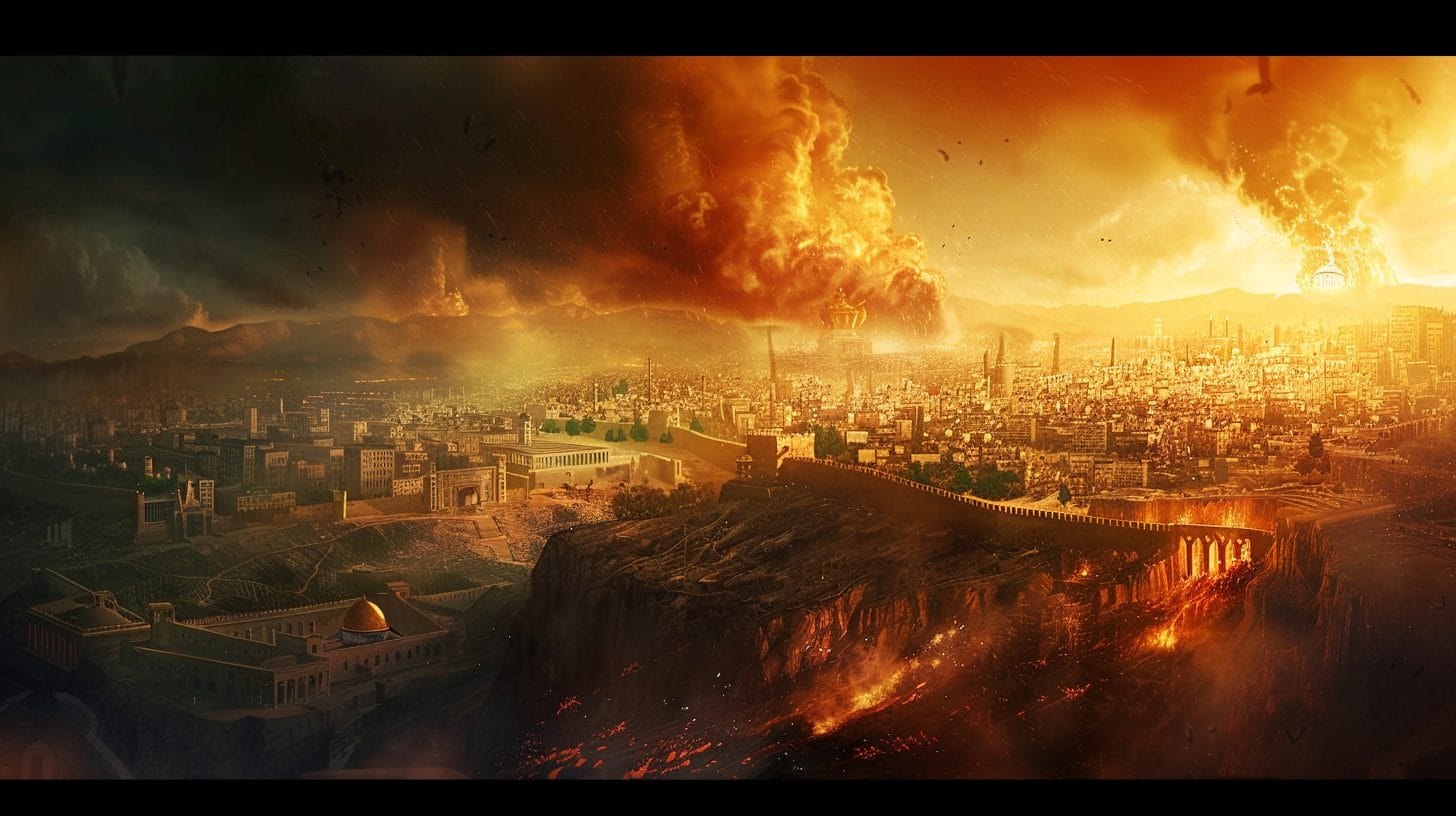
Scripture does not identify Gog and Magog with one modern nation by name. In Ezekiel 38–39, Gog is the leader of a coalition from the land of Magog, associated with Meshech and Tubal and joined by peoples from several regions. The ancient names point broadly toward Anatolia, the Black Sea world, and territories north and east of Israel, but they do not justify saying “Gog is Russia,” “Magog is Turkey,” or any other modern equation with certainty.
Quick answer: Gog is the hostile ruler in Ezekiel’s prophecy; Magog is his land or people. The coalition uses real ancient names, but the passage does not give a one-to-one map of current borders. Modern identifications should therefore be stated as possibilities, never as revealed facts.
Why the Identification Question Matters
Gog-and-Magog teaching often reaches readers through headlines before they read Ezekiel. Wars, alliances, energy disputes, and regional tensions are placed beside a map, and ancient names are assigned to current countries. Some geographic comparison is legitimate. The problem begins when a plausible regional connection is presented as if Ezekiel supplied a modern passport.
The stakes are pastoral as well as interpretive. Overconfident identifications can make ordinary citizens appear to be predetermined prophetic villains, turn every diplomatic shift into a countdown, and damage confidence when the prediction changes. A careful reading should preserve the prophecy’s future force while refusing certainty the text does not provide.
Gog and Magog in Ezekiel’s Setting
Ezekiel 33–37 moves from Jerusalem’s fall toward restoration: a faithful shepherd, renewed land, spiritual cleansing, resurrection imagery in the dry bones, and reunited Israel under one Davidic king. Ezekiel 38–39 then depicts an overwhelming invasion after restoration. God draws Gog against the land, defeats the coalition by earthquake, confusion, pestilence, hail, fire, and sulfur, and makes His holy name known among Israel and the nations.
The oracle’s center is therefore not the invader’s modern nationality. It is God’s public vindication. Israel does not win because of superior weapons. Gog becomes the stage on which God demonstrates that He rules the nations, judges predatory power, protects His purposes for Israel, and will no longer allow His holiness to be profaned.
What the Names Say—and What They Do Not
Gog is described as being “of the land of Magog” and as the chief prince, or prince of the chief, of Meshech and Tubal. Whether “Gog” is a personal name, throne name, or symbolic title, the text treats him as the coalition’s leader. Magog also appears in Genesis 10:2 among Japheth’s descendants, placing the name inside the Bible’s ancient table of nations.
Meshech and Tubal are best compared with peoples known from Anatolia and the ancient Near East, often associated with the Mushki and Tabal in Assyrian records. Gomer is commonly related to Cimmerian peoples who moved around the Black Sea and Anatolia. Beth-togarmah is likewise placed in a northern Anatolian or Armenian setting. These identifications locate an ancient horizon; they do not establish uninterrupted descent into one present citizenship.
The coalition is deliberately international. Persia points east of Israel; Cush and Put point south and west; Gomer and Beth-togarmah are described from the far north. Ezekiel’s picture is broader than a solitary northern superpower. The many directions emphasize the scale of the threat and the universality of God’s victory.
Does “Rosh” Mean Russia?
Some English treatments translate Ezekiel 38:2 as “the prince of Rosh, Meshech, and Tubal” and then connect Rosh with Russia. Other translations understand the same Hebrew construction adjectivally: “chief prince of Meshech and Tubal.” Even if Rosh is taken as a proper place name, similarity to the much later word “Russia” does not prove identity. Historical linguistics requires more than shared sound.
The same caution applies to connecting Meshech with Moscow and Tubal with Tobolsk. Those equations became popular because the words sound somewhat alike in modern European languages, but ancient evidence locates Meshech and Tubal much closer to Anatolia. A prophecy interpretation should move from the Hebrew text and ancient records toward modern geography, not from a modern map backward through English pronunciation.
The Main Modern Proposals
Russia or a Russian-led coalition
The Russia proposal appeals to the repeated “far north” language, the Rosh translation, and Russia’s obvious position north of Israel. It may also connect the coalition’s military scale with a large modern power. This reading correctly notices that geography matters and that Ezekiel expects a real international assault. It becomes too confident when a northward direction is treated as a national name or when current policy is made to fulfill details the text does not mention.
Turkey or an Anatolian-centered coalition
An Anatolian proposal begins with stronger ancient associations for Meshech, Tubal, Gomer, and Togarmah. It can therefore claim better historical geography than the Moscow-Tobolsk argument. Yet ancient Anatolia now spans modern borders and hosted many changing peoples. The evidence supports a regional connection more readily than the claim that one current state exhausts the prophecy.
A broad future coalition using ancient names
A third approach expects a future invasion involving territories represented by the ancient names without insisting on exact modern succession. This respects the oracle’s geographical texture and leaves room for political configurations that do not yet exist. Its weakness is that it can become so broad that no proposed identification could ever be tested.
Symbolic or archetypal evil
Some interpreters understand Gog primarily as the final enemy of God’s people, using the nations as an archetypal picture rather than a forecast requiring ethnic continuity. This view rightly recognizes the oracle’s theological and literary character and explains why Revelation can reuse Gog and Magog for a worldwide rebellion. It may understate the concrete land, peoples, burial, and restoration details in Ezekiel.
The Strongest Case for a Specific Modern Identification
The strongest modern-identification argument is cumulative rather than etymological. It says Ezekiel names peoples historically located north of Israel, describes an immense latter-days coalition, and portrays a restored Israel at the center of international conflict. A major power from the north could lead allies from regions corresponding broadly to the names. Russia or Turkey may therefore be plausible candidates depending on how the ancient geography and future politics are weighed.
This case gets three things right: Ezekiel intends geography to communicate something; the invasion is not merely a private spiritual struggle; and future political arrangements can make old regional descriptions newly relevant. The disagreement is over necessity. None of those points turns a plausible candidate into an inspired identification. Scripture gives enough information to recognize the kind of coalition and God’s purpose in defeating it, but not enough to name today’s leader in advance.
How Revelation 20 Reuses Gog and Magog
Revelation 20:7–10 describes Satan’s release after the thousand years and his deception of “the nations that are at the four corners of the earth, Gog and Magog.” The force is worldwide, not confined to Ezekiel’s named coalition. Fire from heaven consumes the attackers. John is using Ezekiel’s enemy names as a biblical designation for the final organized rebellion against God.
That reuse does not require Ezekiel 38–39 and Revelation 20 to be the same event. Ezekiel includes seven months of burial and seven years of burning weapons, focuses on Israel’s land, and places the battle within an extended restoration oracle. Revelation places its Gog-Magog uprising after the millennium immediately before final judgment. Repeated names can identify a recurring pattern—the last enemy coalition—without collapsing the two literary sequences.
What Gog and Magog Do Not Establish About Rapture Timing
Ezekiel never describes the catching up of the church. Proposals place the invasion before Daniel’s final week, early in it, at its midpoint, near Christ’s public return, during the millennial transition, or after the millennium by equating it with Revelation 20. The seven-year weapon-burning and seven-month burial periods constrain those proposals, but they do not produce one uncontested date.
The battle can fit within a futurist and pre-tribulation framework, yet it cannot prove that framework by itself. The rapture question must be decided from passages about Christ receiving His people, resurrection and transformation, gathering, wrath, lawlessness, and the day of the Lord. Ezekiel contributes Israel’s future restoration and God’s defeat of a latter-days invader.
How to Read Current Events Responsibly
Begin with what the text states: a future or climactic enemy leader, a multinational coalition, restored Israel, overwhelming invasion, direct divine judgment, and worldwide recognition of God’s holiness. Then distinguish historical geography from modern application. Ancient associations may suggest regions; they do not confer prophetic guilt on everyone living there now.
Current events may illustrate how coalitions form, but they should not become the controlling commentary. Do not announce fulfillment from one military exercise, treaty, election, or pipeline. Do not treat a news report as proof that “the hook in the jaw” has been identified. Teachers should disclose which part of a claim comes from Ezekiel, which from ancient history, and which from present speculation.
A Bounded Conclusion and Pastoral Takeaway
Gog is the leader of Ezekiel’s hostile coalition, and Magog is his land or people. The ancient names create a real northern and international horizon, with especially strong Anatolian and Black Sea associations for several members. They do not reveal a certain modern nation-by-nation map. Russia, Turkey, or another future alignment may fit aspects of the geography, but no present equation should be preached as explicit Scripture.
Ezekiel’s pastoral emphasis is steadier than a changing map. Predatory power can appear irresistible, but God is not surprised, Israel’s restoration is not outside His control, and the nations will not mistake the final victory for human strength. Responsible prophecy teaching should produce humility toward what remains unidentified, restraint toward living peoples, and confidence in the holiness and sovereignty of God.
Works Cited
The Holy Bible, especially Genesis 10:1–5; Ezekiel 33–39; and Revelation 20:7–10. These passages supply the table-of-nations background, Gog oracle, restoration setting, and later worldwide reuse of the names.
Block, Daniel I. The Book of Ezekiel, Chapters 25–48. New International Commentary on the Old Testament. Eerdmans, 1998. Block is used for the oracle’s literary placement, ancient geography, and emphasis on God’s public vindication.
Cook, Stephen L. Ezekiel 38–48. Anchor Yale Bible 22B. Yale University Press, 2018. Cook provides a recent critical reading that tests overly literal modern-national and chronological claims.
Mounce, Robert H. The Book of Revelation. Revised edition. New International Commentary on the New Testament. Eerdmans, 1997. Mounce is used for Revelation 20’s worldwide reuse of Gog and Magog after the millennium.
Yamauchi, Edwin M. Foes from the Northern Frontier: Invading Hordes from the Russian Steppes. Baker Book House, 1982. Yamauchi supplies historical evidence for Cimmerians, Scythians, Mushki, and Tabal and evaluates popular Russia identifications.
Zimmerli, Walther. Ezekiel 2. Hermeneia. Fortress Press, 1983. Zimmerli represents a major non-dispensational treatment of Ezekiel’s final oracles and provides a check on newspaper-driven futurism.