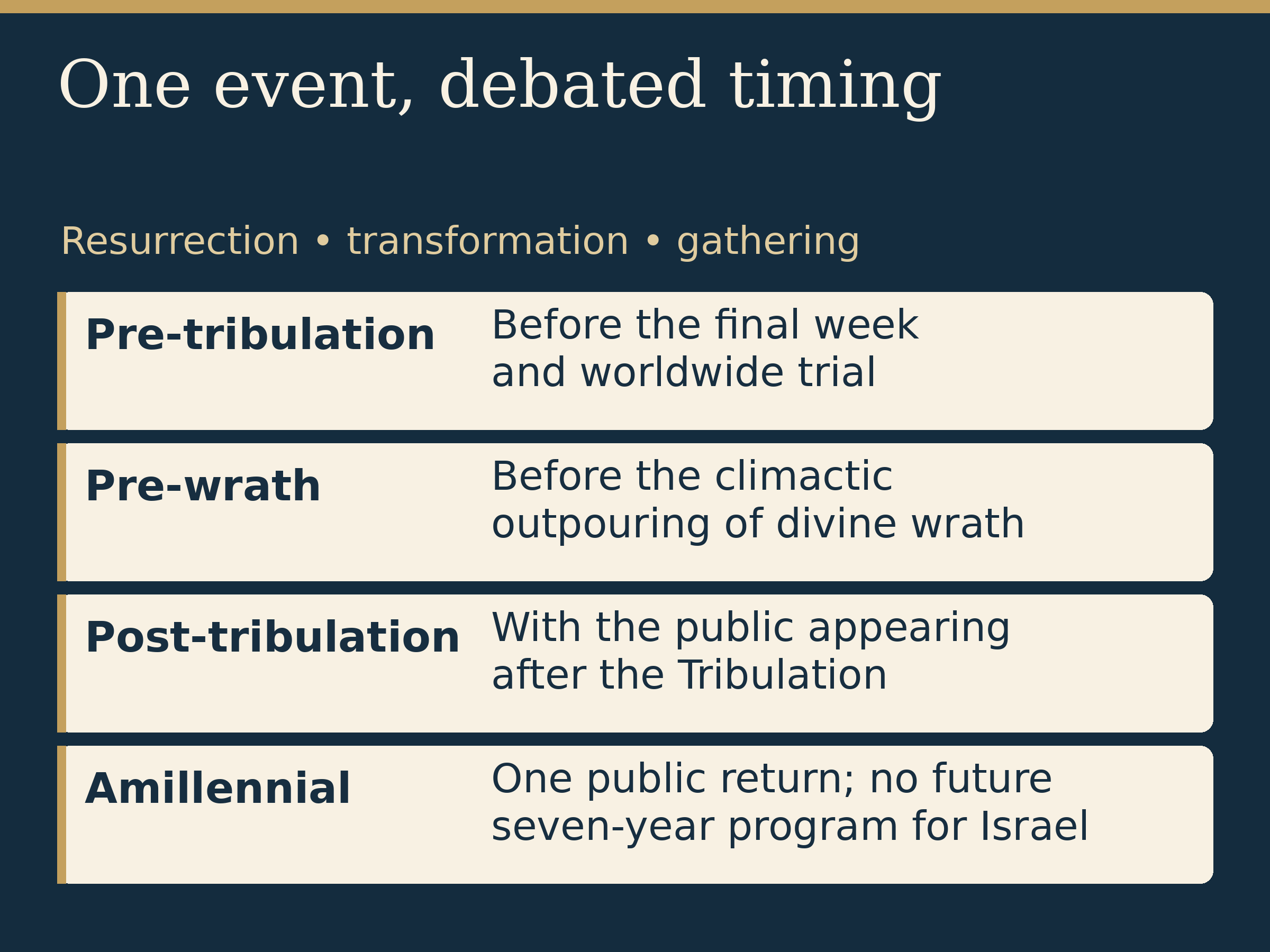
The pre-tribulation rapture is the belief that Jesus Christ will gather deceased and living believers to Himself before the future period of worldwide judgment often called the Tribulation. The event includes resurrection, bodily transformation, and being caught up to meet the Lord in the air. Its purpose is not to promise Christians an easy life now. It is to explain the church’s hope in Christ and its relation to the coming day of divine wrath.
The New Testament teaches the gathering itself in 1 Thessalonians 4:13–18 and 1 Corinthians 15:50–54. The timing is the debated part: pre-tribulation describes when this gathering occurs, not a different kind of resurrection.
The Event in Ordinary Language
Paul gives the clearest sequence in 1 Thessalonians 4:13–18: the Lord descends, the dead in Christ rise, living believers are caught up with them, and all meet the Lord in the air. First Corinthians 15:50–54 explains the bodily change: mortality puts on immortality and the perishable becomes imperishable. This is not an escape of disembodied souls. It is a resurrection event centered on Jesus’ victory over death.
Christians who disagree about the timing can still agree on the bodily return of Christ, resurrection, judgment, and the final renewal of creation. Their disagreement concerns how the gathering relates to the Tribulation and Christ’s public appearing.
Who Takes Part?
Paul describes “the dead in Christ” and living believers. The phrase points to those united to Christ, not to an especially faithful subgroup who has reached a higher spiritual level. The rapture is not a reward reserved for Christians who correctly solve prophecy. Salvation rests on Christ’s work, and the resurrection hope belongs to His people.
This does not mean every believer receives the same reward or that faithfulness is unimportant. The New Testament distinguishes salvation from evaluation and reward. But it gives no sound basis for a “partial rapture” in which ordinary believers are abandoned because they did not achieve a special degree of readiness.
Where Are Believers Received?
In John 14:1–3 Jesus comforts His disciples by speaking of His Father’s house, prepared places, His return, and His promise to receive them to Himself. Pre-tribulation interpreters understand this as destination language: Christ takes His people to be where He is. John 14 does not state the timing relative to the Tribulation.
The argument for an earlier gathering combines this promise with passages about divine wrath, Israel, and the church’s expectancy. The best case for the pre-tribulation rapture develops that argument passage by passage.
What About Christian Suffering?
Pre-tribulationism does not teach that Christians avoid persecution, grief, illness, martyrdom, or ordinary tribulation. Jesus said His followers would have tribulation in the world. The apostles prepared churches to suffer faithfully. Many believers have endured severe persecution, and Christians should never use rapture hope as an excuse to ignore their suffering.
The claim is narrower: the church is not appointed to the future outpouring of divine wrath associated with the day of the Lord. Present tribulation often comes from a hostile world; eschatological wrath comes from God’s judicial action. That is a claim about future judgment, not a promise of comfort in this life.
The Major Timing Views
| View | Basic claim | Text it presses hardest |
|---|---|---|
| Pre-tribulation | The church is gathered before Daniel’s final week and the worldwide hour of trial. | 1 Thessalonians 5:9; Revelation 3:10 |
| Pre-wrath | The church enters much of the Tribulation but is gathered before the climactic outpouring of divine wrath. | Matthew 24:29–31; Revelation 6:17 |
| Post-tribulation | The gathering and public appearing occur together after the Tribulation. | Matthew 24:29–31; 2 Thessalonians 2 |
| Amillennial or non-dispensational approaches | The rapture belongs to Christ’s one public return, without a separate future seven-year program for Israel. | 1 Thessalonians 4 read with the general resurrection |
The central disagreement is whether the gathering and Christ’s public appearing are one event or distinguishable movements in His coming. Matthew 24:29–31 places a gathering after the Tribulation; interpreters differ over whether it is the same gathering Paul describes.
Terms You Will Encounter
- Rapture
- A theological label drawn from the Latin translation of Paul’s verb “caught up”: believers are raised or transformed and gathered to Christ.
- Tribulation
- In pre-tribulation teaching, the future worldwide judgment period associated with Daniel’s final prophetic week. This differs from the ordinary suffering Christians endure now.
- Day of the Lord
- The time of divine judgment discussed in 1 Thessalonians 5. Its relationship to the gathering is part of the timing debate.
- Imminence
- The expectation that Christ may gather His church without a revealed event that must occur beforehand. Imminence and prophetic prerequisites explains why Christians disagree about that expectation.
- Public appearing
- Christ’s visible return in judgment and kingdom glory, which pre-tribulation interpreters distinguish from His earlier gathering of the church.
None of these terms gives a date for Christ’s return or makes agreement about the timing a condition of salvation.
The Promise Behind the Debate
Believers who die in Christ are not lost, living believers will not have an advantage over them, death will be defeated, and the church will be with the Lord. That is the comfort at the center of Paul’s instruction.
Scripture and Further Reading
The Holy Bible, especially John 14:1–3; 1 Corinthians 15:50–58; 1 Thessalonians 1:9–10; 4:13–18; 5:1–11; 2 Thessalonians 2:1–12; Daniel 9:24–27; Revelation 3:10; 19–20. These passages define the event and the principal timing questions.
Blaising, Craig A., Alan Hultberg, and Douglas J. Moo. Three Views on the Rapture: Pretribulation, Prewrath, or Posttribulation. Edited by Stanley N. Gundry. Zondervan, 2010.
Green, Gene L. The Letters to the Thessalonians. Pillar New Testament Commentary. Eerdmans, 2002.
Ladd, George Eldon. The Blessed Hope. Eerdmans, 1956.
Walvoord, John F. The Rapture Question. Revised and enlarged edition. Zondervan, 1979.