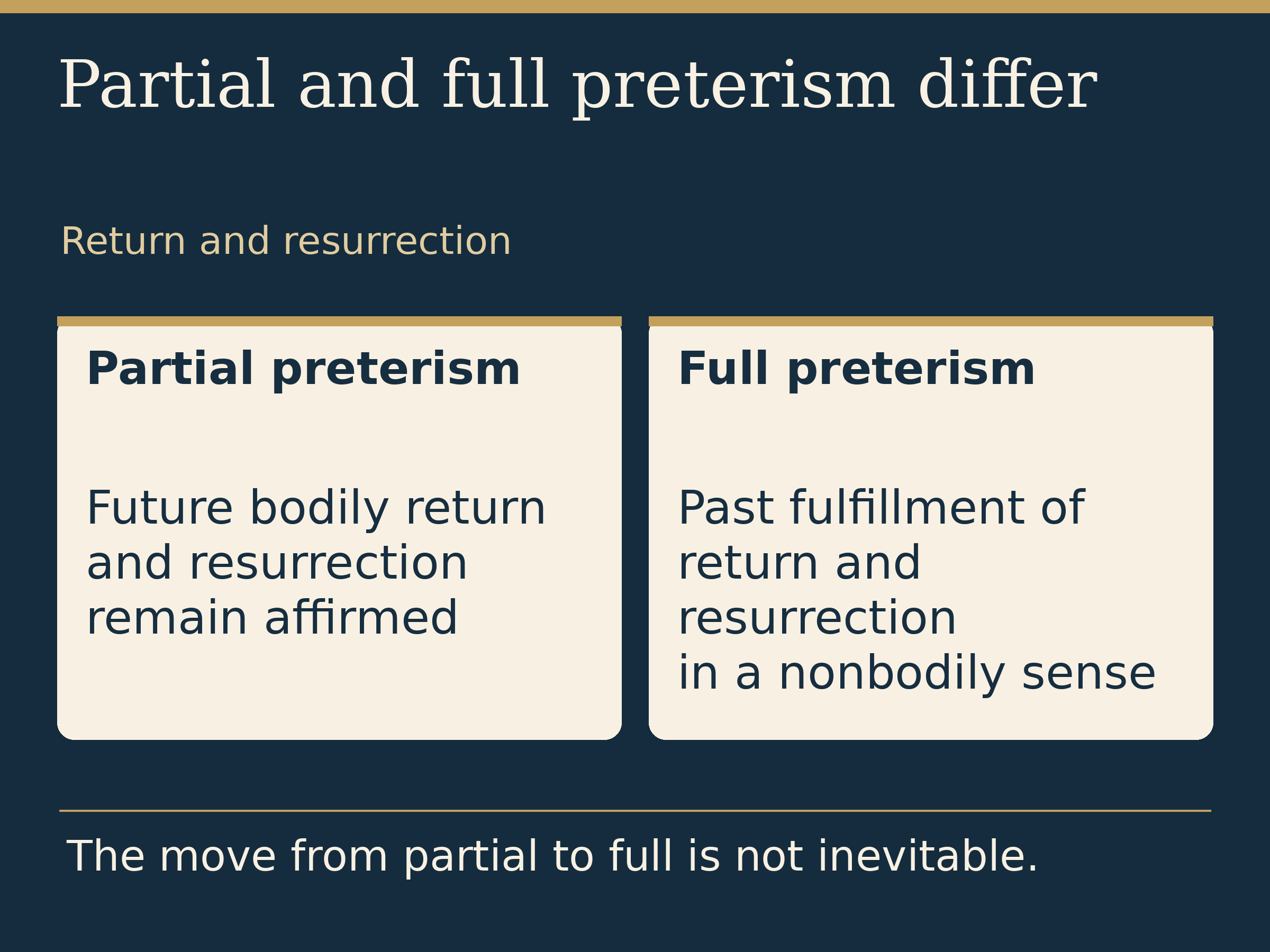
Partial preterism can create pressure toward full preterism when “soon” and “near” are treated as a single controlling rule for every vision in Revelation. But the move is not logically inevitable. Partial preterists distinguish first-century judgments from the still-future bodily return of Christ, resurrection of the dead, final judgment, and renewal of creation. The real question is whether those boundaries arise from the texts themselves or are imposed only to avoid a conclusion.
A Dispute About Future Hope, Not Hidden Allegiances
This is more than a dispute over labels. Partial preterism remains within historic Christian orthodoxy because it affirms a future visible return of Christ, bodily resurrection, and final judgment. Full preterism places those events in the past, commonly identifying them with covenantal or spiritual realities surrounding Jerusalem’s fall in AD 70. That removes the future consummation affirmed in passages such as Acts 1:9–11, 1 Corinthians 15:20–28, 1 Thessalonians 4:13–18, and Revelation 20:11–21:5.
Partial preterists are not secretly full preterists, nor is every first-century fulfillment a step toward full preterism. Jesus plainly predicted Jerusalem’s judgment, and New Testament prophecy addressed real first-century churches. The narrower question is whether a partial-preterist use of Revelation’s time statements can consistently stop before making the whole book past.
What Partial Preterism Actually Claims
Partial preterism holds that substantial portions of New Testament prophecy were fulfilled in the events leading to Jerusalem’s destruction and in the early conflict between the church, Judaism, and Rome. Its advocates differ among themselves. Some place most of the Olivet Discourse in the first century. Some read Revelation primarily against Nero, imperial Rome, or apostate Jerusalem; the identification of Babylon is one point of disagreement. Most nevertheless retain future realities that cannot be reduced to AD 70: Christ’s personal return, the resurrection of all people, the last judgment, and the final state.
Full preterism goes farther. It treats the Second Coming and resurrection language as fulfilled in a nonbodily or covenantal sense. The dispute concerns where partial preterists draw the boundary between fulfilled judgment and future consummation.
Revelation’s Time Statements
The pressure begins with phrases at both ends of Revelation. The book opens with events that “must soon take place” and says “the time is near” (Revelation 1:1, 3). It closes with the same language: “these words are trustworthy and true,” the Lord says that He will come quickly, and the time is near (22:6–7, 10, 12, 20). Partial preterists rightly insist that these statements meant something to the seven churches that first heard them. A reading that makes the whole book irrelevant for many centuries fails to respect its pastoral setting.
The difficulty is that the closing time statements follow visions of Satan’s final defeat, the judgment before the great white throne, the end of death and Hades, and the new heaven and new earth. If “near” proves that earlier judgments had to occur by AD 70, why does the same language not place Revelation 20–22 there as well?
That question creates genuine interpretive pressure. It does not by itself settle the answer. Apocalyptic books can recapitulate events, move between historical and consummate horizons, and apply the certainty of the end to every generation. But a view that uses proximity language decisively in one section must explain why that language functions differently when the book reaches resurrection and final renewal.
The Strongest Partial-Preterist Answer
The strongest partial-preterist response is not simply to ignore Revelation’s final chapters. It argues that the book contains more than one horizon. Its visions address the first-century crisis while also reaching beyond it. The judgment of a persecuting city or empire can be near, and that historical judgment can anticipate the final victory portrayed later. Repetition of “I am coming” need not make every divine coming identical; Scripture can use coming language for historical judgments as well as Christ’s final appearing.
This answer has real strengths. It recognizes prophetic patterns, honors the original audience, and refuses to flatten every occurrence of similar language into one event. Futurists use comparable distinctions when they see near historical judgments in Isaiah or Joel that also supply language for the day of the Lord. A partial preterist is therefore not inconsistent merely because one prophecy has an initial fulfillment while another remains future.
The answer becomes weaker, however, if the boundary is asserted rather than demonstrated. Revelation 20–22 contains events of a different order from the fall of a city: the resurrection and judgment of the dead, the removal of death, and creation made new. These features supply textual reasons for a future horizon. The distinction should rest on those features, not only on a prior commitment to preserve orthodoxy.
What Partial Preterism Gets Right
Partial preterism corrects several common futurist habits. Revelation was written to actual churches, not merely to readers at the end of history. The book’s calls to endurance, repentance, and worship had immediate force. Jerusalem’s fall is important to New Testament interpretation, especially in passages that explicitly concern the temple and that generation. Prophetic language also draws heavily on Old Testament descriptions of historical judgment, where cosmic imagery does not always mean the end of the physical universe.
The alternative to full preterism is not a prophecy system in which nothing mattered before modern times. A sound futurist reading can affirm first-century referents, recurring patterns of beastly power and Babylon-like corruption, and a final consummation that exceeds every historical preview.
Where the Pressure Becomes Strongest
The pressure toward full preterism becomes strongest when three moves are combined. First, every statement about nearness is required to reach complete fulfillment within the first-century audience’s lifetime. Second, coming, resurrection, or new-creation language is routinely spiritualized when a bodily or cosmic reading would extend beyond AD 70. Third, no clear textual criterion is offered for deciding which events remain future.
Applied consistently, those moves can absorb the final resurrection and judgment into the past. But partial preterists need not make all three moves. They can treat AD 70 as a real fulfillment of some prophecies while allowing typological escalation and final consummation. They can also argue from passages outside Revelation that Christ’s return and resurrection remain bodily and public.
Texts That Establish a Future Boundary
Acts 1:9–11 describes Jesus returning in correspondence with His visible ascension. First Corinthians 15 ties Christ’s coming to the resurrection and transformation of those who belong to Him, followed by the defeat of death. First Thessalonians 4 describes deceased believers rising and living believers being gathered with them. Second Peter 3 connects the day of the Lord with final judgment and the promised new heavens and new earth.
Revelation’s own sequence reinforces that boundary. Revelation 20:11–15 portrays all the dead before God’s throne and death and Hades cast into the lake of fire. Revelation 21:1–5 then announces the end of death, mourning, crying, and pain in the new creation. Whatever first-century fulfillments the book contains, those claims have not been exhausted by Jerusalem’s destruction.
A Better Consistency Test
Instead of asking whether a view uses the same calendar answer everywhere, test its interpretive reasons:
- Does the proposed fulfillment fit the passage’s stated audience and scope?
- Does the text describe a historical judgment, the final consummation, or a pattern that joins both?
- Are bodily resurrection and visible-return details allowed their ordinary force?
- Is a change of horizon signaled by the passage’s content and structure?
- Would the interpretation still be adopted if no theological label were at stake?
These questions place the burden on exegesis rather than slogans such as “consistent preterism” or “consistent futurism.” Consistency means applying sound interpretive principles, not forcing every prophecy into one date.
The Hope Still Ahead
Eschatology should strengthen the church’s future hope, not reduce disagreement to labels. Christians can acknowledge fulfilled judgment, learn from interpreters who emphasize the first-century audience, and still confess that Christ will return, the dead will be raised, evil will be judged, and creation will be renewed. Those promises deserve careful boundaries because they are the church’s hope, not merely pieces in a debate.
Scripture and Further Reading
- DeMar, Gary. Last Days Madness: Obsession of the Modern Church. 4th ed., American Vision, 1999. A partial-preterist argument for first-century fulfillment and audience relevance.
- Gentry, Kenneth L., Jr. Before Jerusalem Fell: Dating the Book of Revelation. American Vision, 1998. An argument for an early date of Revelation.
- Osborne, Grant R. Revelation. Baker Exegetical Commentary on the New Testament, Baker Academic, 2002. Commentary on Revelation’s structure, first-century setting, and future consummation.
- Sproul, R. C. The Last Days According to Jesus. Baker Books, 1998. A partial-preterist distinction between first-century fulfillment and the still-future return and resurrection.
- The Holy Bible, especially Acts 1:9–11; 1 Corinthians 15:20–28, 50–58; 1 Thessalonians 4:13–18; 2 Peter 3:3–13; and Revelation 1:1–3; 20:11–21:5; 22:6–20. These passages describe nearness, visible return, bodily resurrection, final judgment, and renewed creation.