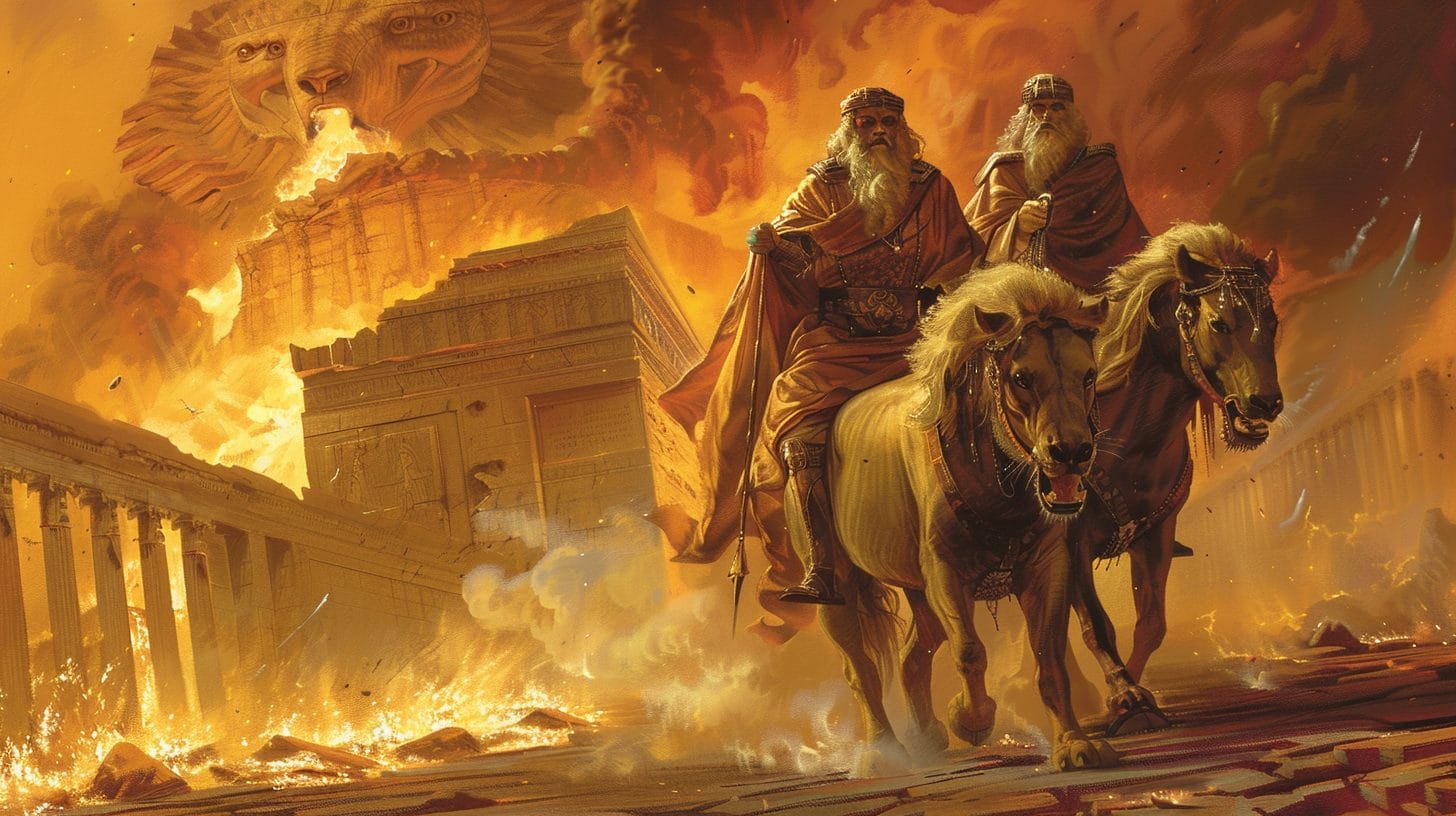
Revelation 11 describes two prophetic witnesses who minister for 1,260 days, are opposed by the beast, are killed, and are raised by God. Their identity has been debated throughout church history. The passage tells readers more about their function than their names, so this article distinguishes what Revelation states directly from broader futurist inferences.
Quick answer: The two witnesses are prophetic servants in Revelation 11; their identity is debated, but their function is clearer than their names.
What Revelation 11 States Directly
- Revelation 11:3-12: The witnesses prophesy, are killed, and are raised.
- Zechariah 4: Lampstand imagery informs Revelation’s description.
- Malachi 4:5: Elijah expectations shape some interpretations.
What Revelation 11 Clearly Says
Revelation 11:3–12 says the two witnesses prophesy for 1,260 days, are clothed in sackcloth, and are described as “the two olive trees and the two lampstands that stand before the Lord of the earth.” They are given extraordinary authority: fire proceeds from them against their enemies, they have power to shut the sky, turn water to blood, and strike the earth with plagues.
When they finish their testimony, the beast kills them. Their bodies lie in the street of the great city, and the world celebrates their deaths. After three and a half days, God raises them, they ascend in a cloud, and a great earthquake follows. Those details are the article’s firm foundation because they come directly from the text.
Their Identity Is Debated
Many interpreters suggest Moses and Elijah because the witnesses’ miracles resemble plagues associated with Moses and drought associated with Elijah, and because Moses and Elijah appeared with Christ at the Transfiguration. Others suggest Enoch and Elijah because neither experienced ordinary death in the Old Testament narrative. Still others argue that Revelation intentionally leaves them unnamed and presents them as two future prophetic servants empowered by God.
Because Revelation 11 does not name them, their identity should not be stated dogmatically. Moses-and-Elijah may be a strong futurist proposal, but it remains an inference.
The Timing of Their Ministry
Some futurist interpreters place the two witnesses in the first half of Daniel’s seventieth week, while others place their ministry in the second half or relate it differently to Revelation’s structure. The 1,260 days connect their ministry to the symbolic and chronological framework of Revelation, but the passage itself does not explicitly say “first half” or “second half.”
It is therefore better to say that their ministry belongs to the end-times sequence described in Revelation. More precise placement depends on how one relates Revelation 11 to Daniel 9, the beast, the temple language, the forty-two months, and the larger structure of the book.
Temple, Covenant, and Israel Claims
Revelation 11 opens with temple-measuring imagery, so many futurist interpreters connect the two witnesses with Jerusalem and temple-centered events. However, the text does not explicitly say that the two witnesses oversee a rebuilt temple, arrange a covenant between Israel and the Antichrist, or personally prepare every detail of Israel’s national response.
Those ideas belong to broader interpretive systems and should be presented as debated inferences. The clearer claim is that their ministry is public, prophetic, centered in the city where their Lord was crucified, and opposed by the beast.
The Purpose of Their Ministry
The two witnesses testify, call attention to God’s authority, confront rebellion, and demonstrate that God’s prophetic word cannot be silenced. Their sackcloth suggests mourning and warning. Their resurrection shows that God vindicates His servants even when the world celebrates their defeat.
Within a futurist reading, their ministry would belong to the end-times sequence described in Revelation, but the passage should not be used for date-setting or speculative predictions. The emphasis is faithfulness, witness, judgment, and divine vindication.
What This Establishes
Revelation 11 establishes that God appoints two prophetic witnesses whose ministry, death, resurrection, and ascension display His authority during the events described in the book. Their function is clearer than their personal identity.
What This Does Not Establish by Itself
The passage does not explicitly identify the witnesses as Moses, Elijah, Enoch, or any named individuals. It does not state that they arrange a covenant, oversee a rebuilt temple, or provide a date-setting sign for Christ’s return. Those claims must be qualified as interpretive inferences, not direct statements of Revelation 11.
Why Revelation Leaves Their Names Unstated
The witnesses’ anonymity keeps attention on their God-given testimony, authority, death, resurrection, and vindication. Moses-and-Elijah and Enoch-and-Elijah proposals may explain selected details, but neither can turn an unnamed text into certainty. Their function is clearer than their identity.
This restraint is pastorally useful. Revelation promises that hostile power cannot end God’s witness before its appointed work is complete, and that apparent defeat is reversed by resurrection. That conclusion does not depend on solving the witnesses’ names.
Why Their Function Is Clearer Than Their Names
The Moses-and-Elijah proposal explains the plague and drought imagery and the Transfiguration association. The Enoch-and-Elijah proposal emphasizes that both figures were taken without an ordinary death, though Hebrews 9:27 is a general statement about human mortality rather than a rule requiring those two men to return and die. A symbolic reading sees the witnesses as the church’s prophetic testimony, often appealing to lampstand imagery. A futurist unnamed-prophets reading accepts two actual servants whose ministries resemble earlier prophets without requiring that they be those prophets.
Revelation itself settles the witnesses’ vocation more clearly than their identity. They prophesy for a defined period, confront a hostile world, finish their testimony, suffer apparent defeat, and are vindicated by God. Holding the names modestly allows the text’s central claim to remain firm: neither the beast nor public celebration can cancel testimony God has commissioned.
Works Cited
The Holy Bible, especially Zechariah 4; Malachi 4:4–6; Matthew 17:1–8; and Revelation 11:1–13. These passages supply the lampstand, prophetic, miracle, death, resurrection, and vindication imagery.
Beale, G. K. The Book of Revelation: A Commentary on the Greek Text. New International Greek Testament Commentary. Eerdmans, 1999. Beale represents the alternative symbolic-corporate reading of the witnesses and tests a strictly individual futurist interpretation.
Mounce, Robert H. The Book of Revelation. Revised edition. New International Commentary on the New Testament. Eerdmans, 1997. Mounce is used for the Moses-Elijah proposal and the immediate flow of Revelation 11.
Osborne, Grant R. Revelation. Baker Exegetical Commentary on the New Testament. Baker Academic, 2002. Osborne surveys the identity options while emphasizing the witnesses’ prophetic function.
Thomas, Robert L. Revelation 8–22: An Exegetical Commentary. Moody Press, 1995. Thomas represents the futurist view that the witnesses are two actual future prophets whose names are not revealed.