Direct answer: the twenty-four elders most likely represent glorified, enthroned believers in heaven, with the church especially in view. Their thrones, crowns, white garments, priestly service, and royal worship echo promises made to Christ’s overcomers in Revelation 2–3. Because they appear around God’s throne before the seals are opened, they fit a pre-tribulation reading of the church in heaven. Yet Revelation never explicitly calls them “the church,” and a serious alternative identifies them as an angelic heavenly council. The conclusion is a strong cumulative inference, not a stand-alone proof of the rapture’s timing.
Why the Elders Matter
The elders occur at strategic moments. They worship the Creator, interpret heavenly scenes for John, present the saints’ prayers, celebrate the arrival of God’s reign, and rejoice over Babylon’s fall. Their identity helps us understand who is already at the throne as judgment begins in chapter 6.
They also illustrate responsible interpretation. Revelation supplies clusters of symbols, not a caption beneath every figure. A good identification must explain all the details, including evidence that resists our preferred view. For the elders, that means taking the textual variants in their song seriously and refusing to turn their early appearance into an explicit rapture narrative.
The Controlling Passage: Revelation 4–5
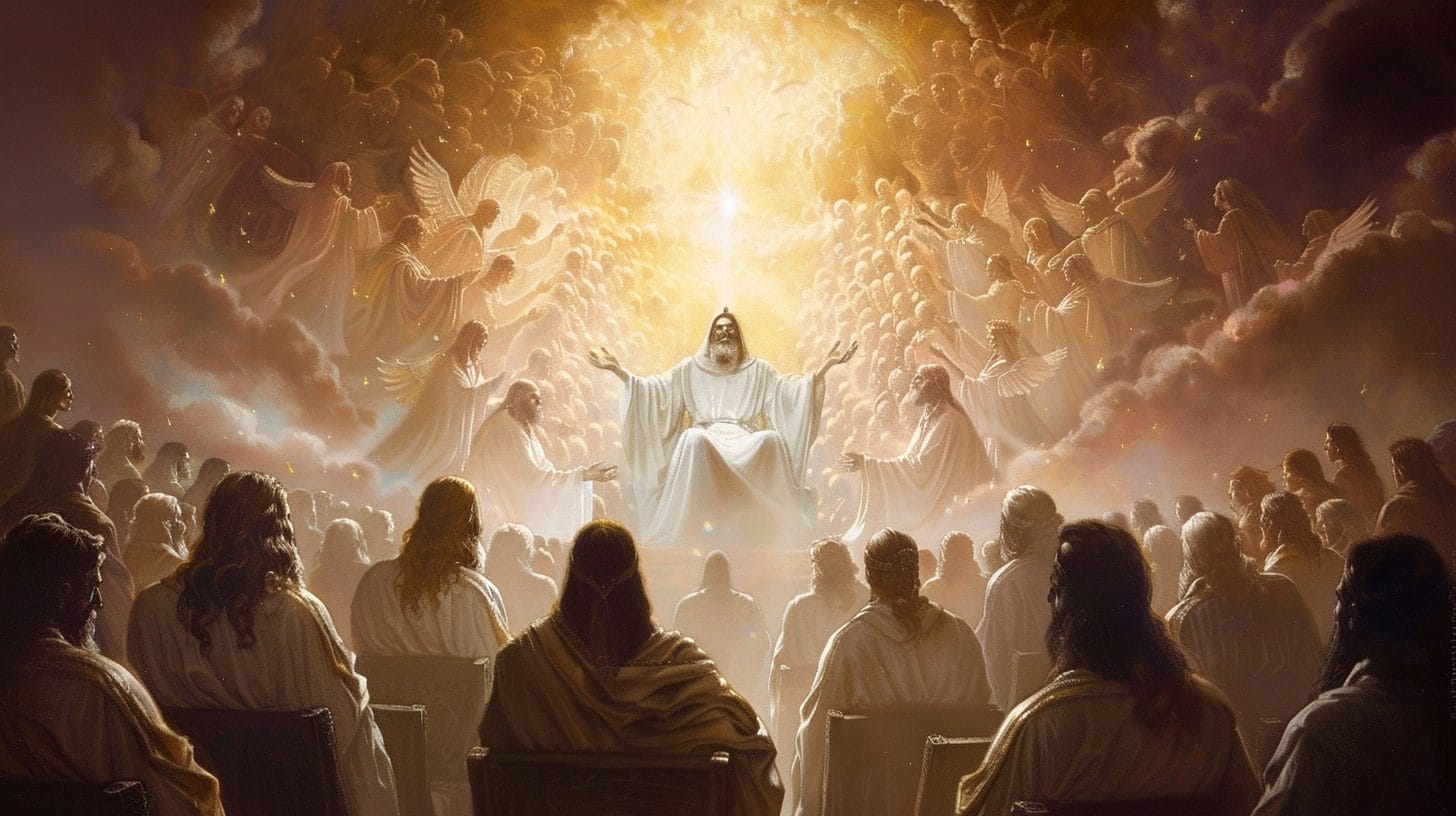
After the seven messages to the churches, John is summoned through an open door in heaven. He sees the throne, the One seated on it, four living creatures, and twenty-four elders seated on twenty-four surrounding thrones. The elders wear white garments and golden crowns. They repeatedly leave their thrones, fall before God, and cast their crowns before Him, confessing that creation exists by His will.
In chapter 5 the question shifts from creation to redemption and rule. The Lamb alone can take the sealed scroll. The living creatures and elders fall before Him with harps and golden bowls identified as the saints’ prayers. They sing a new song about the Lamb purchasing a people from every tribe, language, people, and nation and making them a kingdom and priests who will reign on the earth. The circle then expands to innumerable angels, every creature, and universal praise.
The scene’s center is not the elders but the worthiness of the Lamb. Any proposed identity must preserve that purpose. Their status is derivative: they sit because God grants rule, wear crowns they cast down, and serve because the Lamb redeemed a kingdom.
Evidence for Redeemed Human Representatives
Thrones, crowns, and white garments
Revelation has just promised the overcomer white garments (3:5), a crown (2:10; 3:11), and a place with Christ on His throne (3:21). The elders then appear wearing the promised clothing and crowns while seated on thrones. This deliberate verbal and visual echo is the strongest evidence that they embody rewarded believers. The Greek word for crown is the victor’s stephanos, used elsewhere in Revelation for promised reward, not only a monarch’s diadem.
Royal-priestly activity
The number twenty-four naturally recalls David’s organization of priests into twenty-four divisions in 1 Chronicles 24. One representative division could stand for a larger worshiping body. Harps and bowls of incense likewise evoke temple service. Revelation calls the redeemed a kingdom and priests in 1:6 and 5:10. The elders therefore look like a complete royal-priestly company represented before God.
Distinction from angels
John repeatedly lists the elders alongside, not within, the angels: the angels stand around the throne, living creatures, and elders in 5:11 and 7:11. Distinction does not prove that the elders are human, because heaven could contain multiple angelic orders. Still, it weakens the simple statement that they are merely twenty-four of the angels just mentioned.
The representative number
Twenty-four may combine twelve patriarchs and twelve apostles, anticipating the New Jerusalem’s twelve tribal gates and twelve apostolic foundations. Or it may derive chiefly from the priestly divisions. Either way, the number suggests representative completeness rather than twenty-four famous individuals whom readers are expected to name.
The Important Textual Question in Revelation 5:9–10
Some English translations based on later manuscripts have the elders sing that Christ redeemed “us” and made “us” kings and priests, which would directly identify the singers as redeemed. The best-attested critical text instead speaks of Christ purchasing people for God and making “them” a kingdom and priests, and says “they” will reign. On that reading, the singers celebrate the redemption of others.
This variant must not be hidden. The third-person reading removes a frequently repeated proof. It does not, however, settle the identity. Biblical worshipers can sing about a group they represent in grammatical third person, and the elders’ clothing and enthronement still echo the overcomer promises. Conversely, first-person language in one part of the textual tradition cannot carry the argument against stronger manuscript evidence. The responsible case rests on the whole portrait.
Major Views
- The glorified church: the elders represent church-age believers rewarded and enthroned in heaven before the seal judgments.
- All redeemed humanity: the twenty-four combine old- and new-covenant people, often symbolized as twelve tribes plus twelve apostles.
- An angelic council: the elders are exalted heavenly beings surrounding God’s throne, comparable to a royal court.
- Ideal representatives of worship: their exact ontology is secondary; they dramatize the worship and reign of God’s redeemed order.
I favor the first view, while allowing that the symbol may reach toward the unity of all God’s redeemed people. The immediate echoes of promises to the seven churches make a church reference more specific than a generic heavenly council.
The Strongest Angelic-Council Case—and What It Gets Right
The strongest opposing case begins with the setting. Ancient royal courts included counselors surrounding a king, and biblical visions show a heavenly council. Isaiah 24:23 even speaks of the Lord reigning before His elders in glory. The elders are already in heaven when John arrives, interpret visions like angelic guides, and in the critical text sing of redeemed people as “them.” Revelation never narrates their resurrection or arrival. Therefore, they may be a distinct order of celestial beings rather than humans.
This case gets three things right. The setting is a throne room, not a photograph of a church service. The third-person song is significant. And temporal presence in a vision does not by itself prove that a prior event occurred chronologically; John is shown heavenly reality through symbolic scenes.
Its main difficulty is the tight correspondence with the overcomer promises. Revelation does not elsewhere promise angels victor’s crowns, white garments, and shared thrones as rewards for faithfulness. Calling the elders an angelic council explains their location and knowledge, but explains their church-like reward imagery less naturally. The redeemed-representative view accounts for both.
What Their Presence Says About Timing—and Its Limits
The elders are seated and crowned before the Lamb opens the first seal. In a futurist reading where the seals initiate the coming judgment, their presence coheres with believers already gathered to heaven. The sequence also fits the transition from direct addresses to the churches in chapters 2–3 to heavenly judgment scenes in chapters 4–5.
But coherence is not demonstration. John’s ascent in 4:1 is a prophetic summons and should not be called the rapture without additional argument. The elders never say when they arrived. Their crowns may represent assured status rather than the completed chronology of an awards ceremony. The pre-tribulation doctrine must be established cumulatively from passages that directly describe resurrection, catching up, wrath, and Christ’s coming. The elders are supporting evidence.
Takeaway
The twenty-four elders are best understood as heavenly representatives of glorified believers, probably highlighting the church as a complete royal priesthood. Their first task is not to provide a timeline but to worship: they surrender their honors to the Creator and praise the Lamb who bought a people for God. Their presence before the seals encourages a pre-tribulation reading, while the textual and symbolic limits require humility. What is certain is more important than what remains inferred—the throne belongs to God, the scroll belongs to the Lamb, and the destiny of the redeemed is worship and reign under Him.
Works Cited
- Aune, David E. Revelation 1–5. Word Biblical Commentary 52A, Word Books, 1997. Aune is used for ancient throne-room parallels and the alternative heavenly-council identification of the elders.
- Beale, G. K. The Book of Revelation: A Commentary on the Greek Text. New International Greek Testament Commentary, Eerdmans, 1999. A major case for understanding the elders as heavenly representatives rather than a simple raptured-church proof.
- Metzger, Bruce M. A Textual Commentary on the Greek New Testament. 2nd ed., United Bible Societies, 1994. Metzger is used to assess the textual variants in Revelation 5:9–10 that affect whether the elders explicitly sing of their own redemption.
- The Holy Bible, especially 1 Chronicles 24; Isaiah 24:23; Revelation 1:4–6; 2–5; 7:9–17; 11:15–18; and 19:1–5. These passages supply the priestly-division background, throne-room setting, reward imagery, and comparisons used to evaluate whether the elders represent redeemed people or a heavenly council.
- Thomas, Robert L. Revelation 1–7: An Exegetical Commentary. Moody Press, 1992. Thomas is used for the dispensational identification of the elders and for exegetical details in Revelation 4–5.